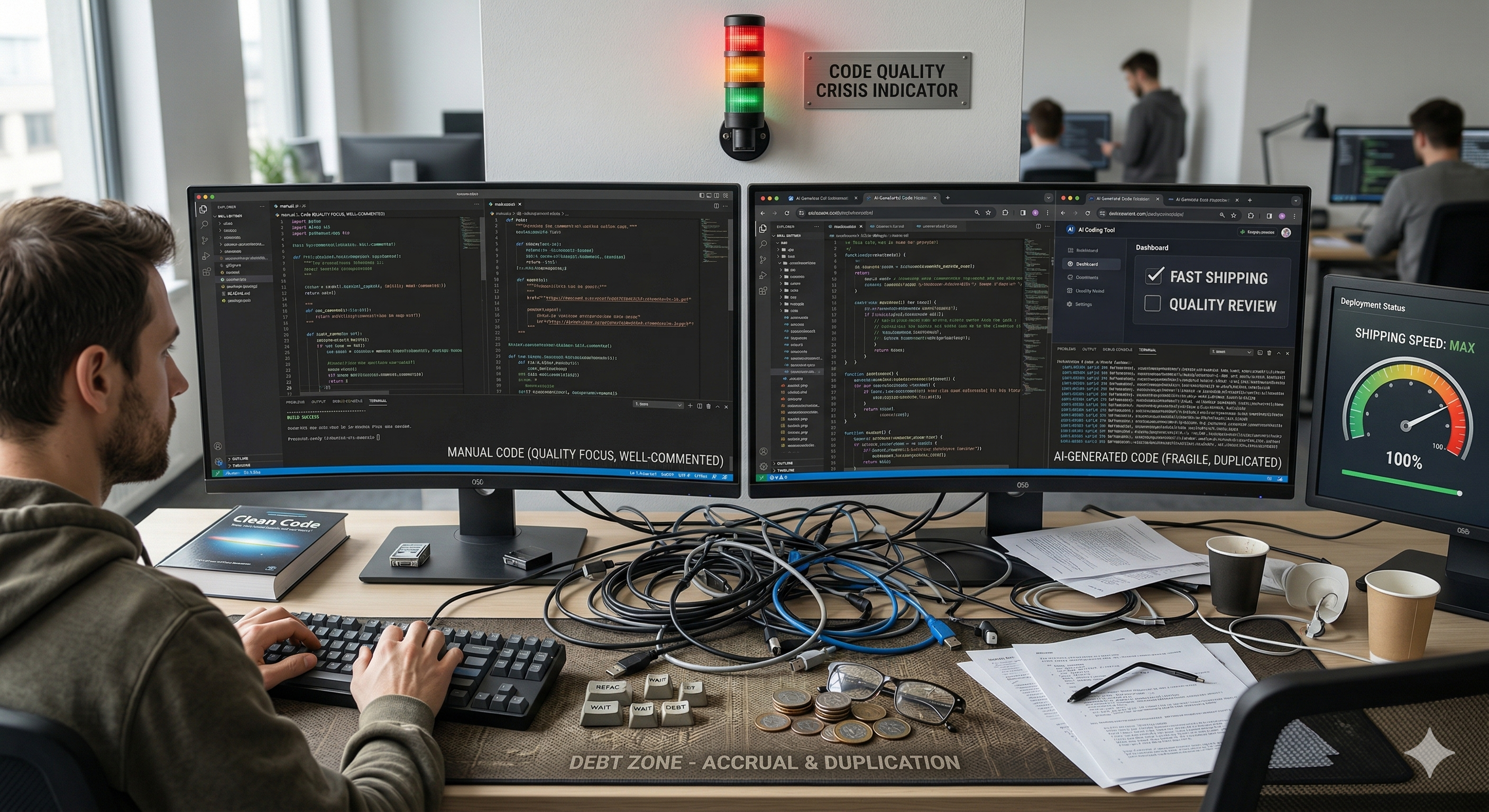
AI coding tools promised a productivity revolution. In many ways, they delivered. GitHub reports that AI now writes 41% of all code on its platform, and developers report saving 30-60% of time on routine tasks. But a troubling pattern is emerging: the faster teams ship AI-generated code, the more it costs them downstream.
The data tells a story that every engineering leader needs to hear.
The Numbers Don’t Lie
A 2026 study by CodeRabbit analysing millions of pull requests found that AI-generated code creates 1.7x more total issues than human-written code. Code duplication — long considered one of the worst code smells — is up 4x in AI-assisted repositories. Cognitive complexity has risen 39% in agent-assisted repos, making code harder to read, review, and maintain.
Perhaps most concerning: research from Stanford and MIT found that 14.3% of AI-generated code snippets contain security vulnerabilities, compared to 9.1% for human-written code. Teams are shipping faster, but they’re also shipping more bugs and more security holes.
The bottom line? Technical debt increases 30-41% after AI tool adoption, and by year two, unmanaged AI code drives maintenance costs to 4x traditional levels.
Three New Types of Technical Debt
The industry is beginning to recognise that AI-assisted development creates debt that doesn’t fit neatly into traditional categories. Addy Osmani, engineering lead at Google, coined the term comprehension debt to describe what happens when teams ship code faster than they can understand it.
This framing resonates because it captures something many engineering teams feel but struggle to articulate. There are now three distinct flavours of AI-induced technical debt:
Cognitive Debt occurs when developers approve and merge code they haven’t fully internalised. The code works, the tests pass, but nobody on the team truly understands the implementation. When that code breaks six months later, debugging takes 3-5x longer because the original context was never built.
Verification Debt is the result of approving diffs you haven’t fully read. AI generates large, plausible-looking pull requests. Review fatigue sets in. Studies show that code churn is expected to double in 2026, partly because AI-generated code that “passed review” needs to be rewritten once its edge cases surface.
Architectural Debt emerges when AI generates working code that violates system design principles. The function does what it’s supposed to, but it duplicates logic from another module, introduces a circular dependency, or bypasses the team’s established patterns. Each instance is small. The cumulative effect is a codebase that fights you.
The Productivity Paradox
Here’s the uncomfortable finding: Stack Overflow’s developer survey found that experienced developers report a 19% productivity decrease when using AI tools. Not an increase — a decrease. Meanwhile, delivery stability has declined 7.2% across the industry even as AI adoption accelerates.
How is that possible? The answer lies in where the time goes. AI shifts effort from writing code to reviewing code, debugging AI-generated edge cases, and untangling architectural decisions that looked correct in isolation but don’t fit the system. For senior engineers especially, the cognitive overhead of verifying AI output can exceed the time saved generating it.
This doesn’t mean AI tools are bad. It means the way most teams use them is incomplete.
Quality Is the Missing Layer
The pattern across every organisation successfully scaling AI-assisted development is the same: they treat quality as infrastructure, not as a manual process bolted on at the end.
Gartner projects that 60% of organisations will adopt CI-integrated security scanning by the end of 2026. Companies doing shift-left testing release 23% faster with half as many production bugs. Vulnerabilities caught in CI cost an average of $1,400 to fix versus $9,500 when found in production.
The organisations getting AI right are investing in three areas:
Automated quality gates in CI/CD. Every AI-generated pull request runs through the same static analysis, security scanning, and architectural validation that human code does. No exceptions. The tools catch what tired reviewers miss.
Developer experience (DevEx) as a discipline. Companies with best-in-class DevEx achieve 60% higher revenue growth. DevEx isn’t about bean bag chairs — it’s about reducing the cognitive load of working in a codebase. When AI increases code volume, reducing cognitive load becomes essential, not optional.
Platform engineering for AI workflows. Gartner predicted that 80% of software engineering organisations would have platform teams by 2026. The DORA report shows adoption already exceeds 90%. Platform teams are now building the guardrails that make AI-assisted development sustainable: standardised templates, automated quality checks, and self-service environments that enforce good patterns by default.
Multi-Agent Development Makes This Urgent
The rise of multi-agent AI systems — Gartner reports a 1,445% surge in enterprise enquiries — amplifies the quality challenge exponentially. When one AI agent writes code, a human reviews it. When five agents work on the same codebase simultaneously, the coordination overhead and quality risk multiply.
Anthropic’s 2026 Agentic Coding Trends Report shows that agents now complete 20 actions autonomously before requiring human input, and autonomous sessions have nearly doubled in length. More autonomy means more code generated between human checkpoints — and more opportunity for quality issues to compound.
Organisations like TELUS, which has deployed 13,000+ custom AI solutions and saved 500,000 hours, succeed because they built the quality infrastructure first. The agents are fast. The guardrails are what make them safe.
What Engineering Leaders Should Do Now
The AI code quality crisis isn’t a reason to stop using AI tools. It’s a reason to invest in the quality layer that makes AI tools productive instead of destructive.
Measure what matters. Adopt a framework like DX Core 4 (Speed, Effectiveness, Quality, Impact) that captures quality alongside velocity. DORA metrics alone won’t tell you if AI is creating debt faster than your team can pay it down.
Shift quality left — and down. Don’t just push testing earlier in the pipeline. Embed quality checks into your platform so developers get fast feedback without extra effort. The industry is moving from “shift left” to “shift down” — baking quality into the developer platform rather than adding it as a manual step.
Treat AI output like junior developer output. It’s fast, it’s eager, and it needs review. Build your processes around that assumption. Automated linting, static analysis, and architectural validation aren’t optional when 41% of your codebase is AI-generated.
Invest in developer experience. Every friction point in your development workflow — slow builds, unclear patterns, missing documentation — becomes a multiplier when AI is generating code at scale. Fix the developer experience, and AI tools become dramatically more effective.
The Bottom Line
AI is the most powerful force multiplier software engineering has ever seen. But a force multiplier amplifies whatever it’s pointed at — including your quality problems. The teams that win in 2026 aren’t the ones generating the most code. They’re the ones generating the most correct code.
Quality isn’t the opposite of speed. It’s the prerequisite.